
THE
LIVERPOOL
CLINIC

CONSULTANT-LED IMAGING IN LIVERPOOL
Diagnostic Ultrasound in Liverpool
Expert imaging. Informed decisions.
Persistent joint or tendon pain? A swelling that hasn’t settled? A lump that needs further assessment?
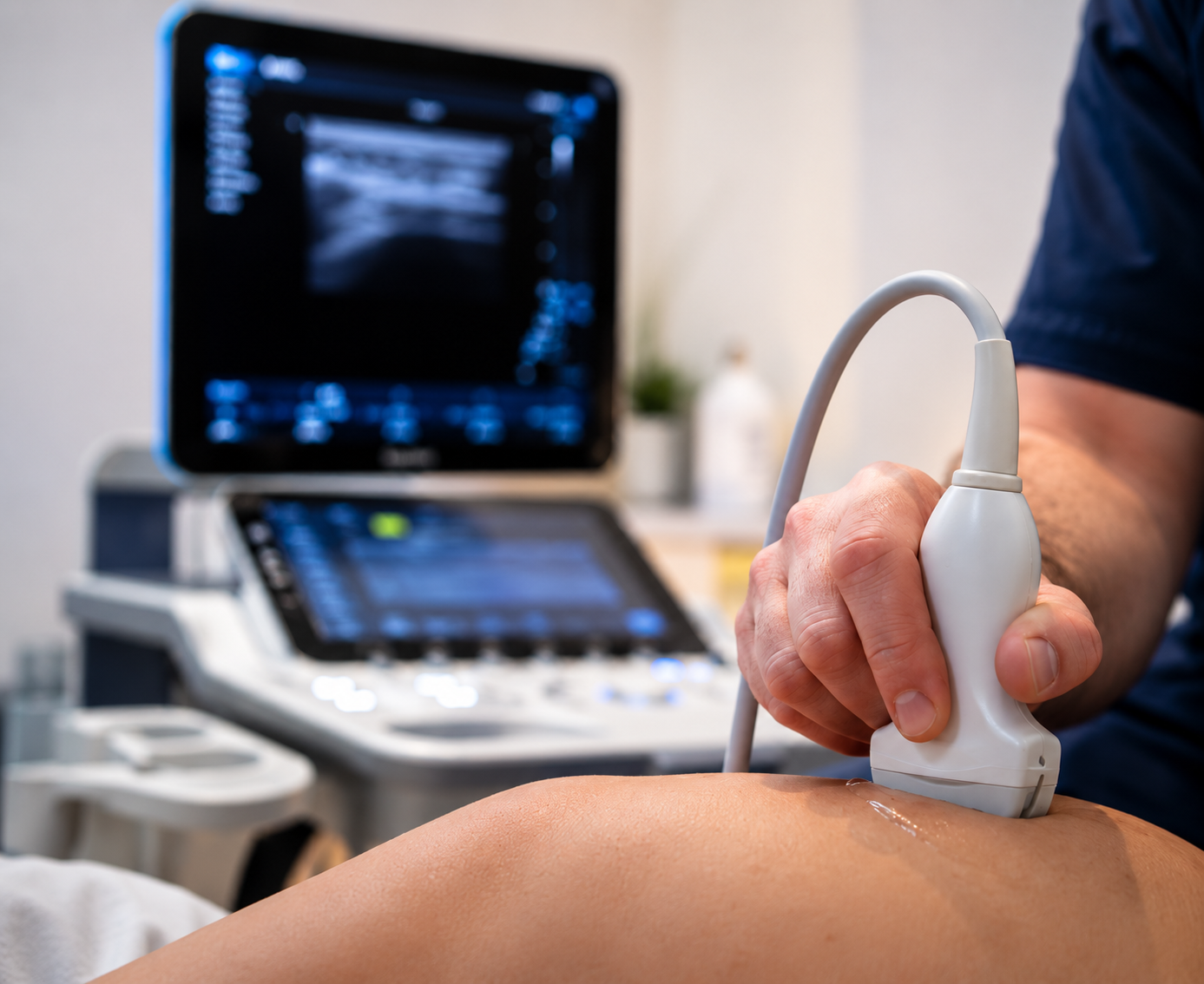
Our consultant-led diagnostic ultrasound service provides specialist real-time imaging for musculoskeletal problems, selected superficial lumps and swellings, and hernias.
Your findings are explained during your appointment and a formal written report is provided.
CONSULTANT EXPERTISE
Specialist imaging in experienced hands
Your diagnostic ultrasound is performed and interpreted by Dr Basu, a Consultant Musculoskeletal
Radiologist with specialist experience in musculoskeletal and sports imaging.
With musculoskeletal ultrasound, clinical expertise matters as much as the technology.

Dr Subhasis Basu, FRCR
Consultant Musculoskeletal & Sports Imaging Radiologist
WHY DIAGNOSTIC ULTRASOUND?
Real-time imaging, tailored to your symptoms
Ultrasound provides detailed, real-time images of structures beneath the skin. Unlike some static investigations, the radiologist can examine structures while you move and relate what is seen on screen directly to your symptoms.
It can be particularly useful for assessing muscles, tendons, ligaments, joints, bursae, superficial nerves, soft- tissue lumps and selected hernias.
WHAT CAN ULTRASOUND ASSESS?
-
Joint, tendon and soft-tissue assessment.
Areas commonly assessed: shoulder, elbow, wrist and hand, hip and surrounding soft tissues, knee, ankle and
foot.
Conditions may include tendinopathy, tendon and muscle tears, ligament injuries, bursitis, joint and soft-tissue
swelling, tenosynovitis, carpal tunnel syndrome, selected superficial nerve problems, Morton’s neuroma and
Baker’s cysts.
-
Assessment of selected superficial lumps and swellings. Ultrasound can help assess the size, depth, position and characteristics of selected superficial soft-tissue lumps and swellings, including suspected lipomas, ganglions, superficial cysts and other selected soft-tissue swellings.
Important: This service does not assess breast, thyroid, neck or testicular lumps. Some lumps require a different or more urgent pathway. New, rapidly enlarging or otherwise concerning lumps should be assessed promptly by a doctor.
-
Dynamic assessment of selected suspected inguinal, groin and abdominal-wall hernias.
The radiologist can examine the area while you move, cough or strain, helping identify changes that may not be apparent at rest.
MORE THAN JUST A SCAN
Diagnostic imaging is most useful when the findings are considered alongside your symptoms and the appropriate next step.
At The Liverpool Clinic, your ultrasound sits within a wider clinical pathway.
✓ Specialist interpretation
✓ Findings explained to you
✓ Formal written report
✓ Treatment where appropriate
✓ Connected onward care including MRI, X-ray, rehabilitation or specialist assessment
STEP 1
TELEPHONE CONSULTATION
We discuss your symptoms, relevant history and any previous investigations. This helps us confirm whether ultrasound is appropriate and ensures you are booked into the right appointment.
YOUR ULTRASOUND JOURNEY
STEP 2
CONSULTANT ULTRASOUND
Your ultrasound is performed and interpreted by a Consultant Musculoskeletal Radiologist.
STEP 4
ONWARD CARE
Depending on the findings, the next step may include treatment, rehabilitation, further imaging or specialist assessment.
STEP 3
FINDINGS EXPLAINED
The findings are discussed with you during your appointment and you receive a formal written report.
THE RIGHT INVESTIGATION MATTERS
Ultrasound is extremely useful for many musculoskeletal and soft-tissue problems, but it is not always the most appropriate test. Sometimes MRI, X-ray or specialist assessment will provide more useful information.
Because your diagnostic imaging sits within The Liverpool Clinic’s wider clinical service, we can advise you if another investigation would be more appropriate and arrange onward referral where clinically indicated.
PATHWAY:
MRI REFERRAL · X-RAY REFERRAL · SPECIALIST ASSESSMENT
FAQ
-
No. You can contact The Liverpool Clinic directly. All patients begin with a telephone consultation so we can review your symptoms and determine whether ultrasound is the appropriate investigation before arranging your scan.
-
Musculoskeletal ultrasound can assess many structures including tendons, muscles, ligaments, joints, bursae and superficial nerves. It can help investigate problems including tendinopathy, tears, bursitis, swelling and selected nerve conditions.
-
Yes. Your consultant will discuss the ultrasound findings with you during your appointment and you will also receive a formal written report.
-
In selected cases, treatment may be possible during the same visit. This depends on the findings, clinical suitability, consent and appointment planning and should be discussed in advance. Treatment is charged separately.
-
No. We assess selected superficial soft-tissue lumps and swellings, including suspected lipomas, ganglions and superficial cysts. Your clinical information is reviewed first to determine whether this is the appropriate investigation.
-
We do not assess breast, thyroid, neck or testicular lumps through this service. Some lumps require a different specialist or urgent pathway, and we will advise you if our service is not appropriate.
-
Not always. Although ultrasound is an excellent investigation for many conditions, sometimes MRI, X-ray or specialist assessment is required. Your consultant will explain the findings and advise whether further investigation should be considered.
-
Where clinically indicated, The Liverpool Clinic can arrange onward referral for MRI, X-ray or specialist assessment.
-
Please check Our Fees Page
-
No. Our diagnostic ultrasound service does not assess spinal conditions, including the neck or sacroiliac joints.
Please note: All services are delivered under practising privileges at CQC registered Crosby Hospital
SPECIALIST PROCEDURE FEES
Fees vary depending on the procedure, complexity and clinical requirements. Your suitability and the appropriate treatment will be confirmed following review of your symptoms, diagnosis and any available imaging. Please visit OUR FEES page for more info.
Ready to take the next step?
If you have persistent joint or tendon symptoms, a soft-tissue swelling or a suspected hernia, start with a consultation with our clinical team.
We’ll review your symptoms and help determine whether diagnostic ultrasound is the appropriate investigation.